



The opportunity for Retail AI is to help customers get better answers and act on them faster. ASOS reports that AI supports around 20% of its buying decisions, while Zalando reported a 63% increase in high-value interactions with its AI Assistant during the first half of 2026. However, a useful answer is not the same as a dependable commitment. Before allowing AI to promise a delivery date, approve a replacement or offer a discount, retailers should ask: who owns the result when that decision reaches the warehouse, the store and the customer?
An attractive offer is only the beginning. Stock must be available, delivery must be achievable and the customer must be eligible. If any of those conditions fail, someone must resolve the problem. Investment decisions should therefore account for the complete outcome, including margin retained, operational work required and the cost of putting things right.
Retailers should give AI more authority only when the business can support that complete outcome, from the offer made to fulfilment, recovery and resolution when something goes wrong. The aim is to give AI enough discretion to solve routine customer problems while setting clear limits on what it may commit the business to doing. This could speed up routine decisions and give colleagues more time for cases requiring judgement. It is an opportunity to test, not a benefit to assume.
The central idea
Give AI more freedom only when the retailer can support the promise it makes and measure the financial and operational effects after the system acts.
Measure the Whole Outcome
Consider a proposed application: handling a replacement when an order cannot be fulfilled as promised. AI can identify suitable alternatives and explain the differences. Connected systems must verify stock, delivery timing, customer eligibility, cost limits and any required approval before an offer is shown. If the checks pass, the system can resolve a straightforward case without manual intervention at every step. If stock cannot be secured or the request falls outside policy, it should be reassessed or sent to a staffed recovery queue.
We propose contribution after resolution as a management measure for assessing an automated retail decision after its downstream costs are known:
Contribution after Resolution = Retained net sales – Goods and routine costs – Exception and recovery costs – AI, integration and operating costs
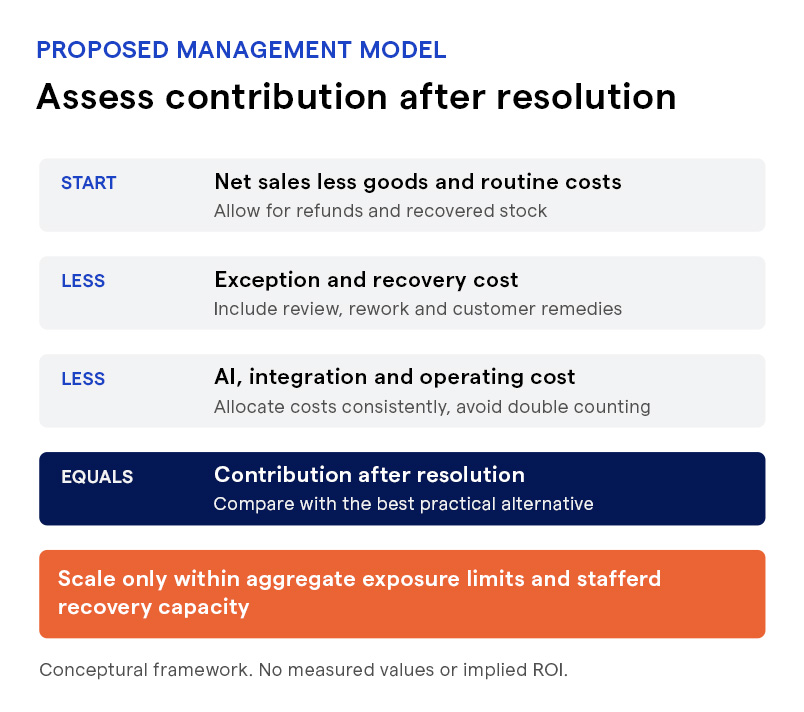
Figure 1. Proposed Management Model. Define cost categories consistently and avoid double counting. Contribution after resolution is not net profit, a standard accounting measure or an observed ROI.
Start with sales retained after cancellations and refunds. Subtract product, standard fulfilment and payment costs followed by manual review, rework, remedies, returns and other recovery costs. Allocate the AI and operating costs attributable to the workflow consistently and avoid double counting.
Track every eligible case across three points:
- Initial decision: resolved automatically, declined or escalated.
- Customer response: accepted, rejected or changed.
- Later result: closed or followed by additional service, second delivery, concession or return costs.
A system that declines an unsuitable action may protect more value than one that completes a transaction but creates a costly failure later.
Turn a Useful AI Answer to Dependable Commitment
A crucial moment comes when an AI-generated alternative becomes a customer-facing promise. A language model can produce a confident error, a risk addressed in NIST’s Generative Artificial Intelligence Profile. So, the response must be checked before it changes money, stock or an order.
Our proposed design gives AI responsibility for interpreting the request, retrieve relevant context and propose an action. The Connected commerce systems responsible for inventory, payments and customer entitlements retain authority to validate and execute it. The assistant communicates a confirmed outcome only after those checks succeed. An uncertain request is reconciled or escalated to a named, staffed recovery queue. It is not retried blindly.
An order management layer translates that approved action into a fulfilment plan using live inventory, delivery constraints and fulfilment rules. Fluent Commerce Order Management illustrates this layer by combining real-time inventory availability and intelligent order orchestration with AI capabilities for sourcing, allocation, reservation and exception handling.
What the customer should experience
A clear choice, a confirmed commitment and a direct route to someone who can help. The complexity should stay behind the scenes.
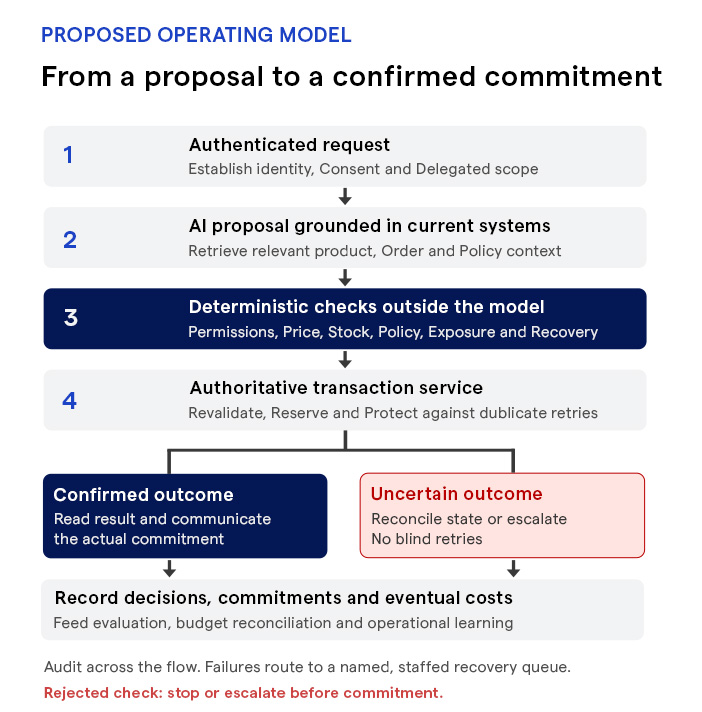
Figure 2. Proposed operating model, informed by NIST, OWASP and Stripe. Ayata’s proposed extension adds exposure and recovery checks. Reserve the relevant allowance at commitment; a prior check alone cannot prevent concurrent overspending. See commercetools resource versioning and its inventory documentation.
The underlying API controls behind this model protect against unavailable-stock promises, stale order updates, duplicate payments and unauthorised concessions. They depend on reliable data and usable transaction interfaces. Physical stock accuracy must be tested alongside database consistency. If a replacement cannot be reserved or its outcome cannot be confirmed, it is not ready to give AI more responsibility.
The broader test is whether AI produces a measurable operational or commercial result. Zalando’s AI-powered SCAYLE STUDIOS platform reached more than 100 brands within 2.5 months, while reducing content-production time by more than 95% and costs by around 90%.
Design for Thousands of Decisions Together
A single replacement may involve a modest concession, stock reservation or service exception. Across thousands of orders, those costs can compound. Before increasing volume, set financial limits, stock allowances, exception capacity and triggers for manual review. Assign an outcome owner with authority to pause the workflow if performance deteriorates.
The workflow must scale with stores, fulfilment teams and customer service. Test whether they can absorb additional decisions and recovery work without degrading service, and give customer service a direct route to report recurring problems.
Albert Heijn, the Dutch grocer, illustrates the operational point. Its AI supports bakery planning, demand forecasting and near-expiry markdowns updated in the app and on electronic shelf labels every 15 minutes. The company says store communication and associate feedback were important to putting its bakery application into practice.
For the replacement process, Finance should define cost treatment, Operations fulfilment limits and Customer Service the recovery standard. If acceptance rises while unresolved work increases, the outcome owner should trace cases through resolution and not release more investment on acceptance alone. Reward completed customer outcomes and the agreed contribution measure, and give the owner authority to reduce volume, change the offer or stop expansion when the combined result deteriorates.
The scaling test
Can the retailer honour and resolve the next thousand commitments as reliably as the next single instance?
Make the Controls Earn Their Cost
A CFO may question the cost of controls, while a COO may argue that stable replacement rules belong in conventional automation. The decisioning choice should therefore compare the AI workflow with the best practical alternative, such as human-supported service or conventional automation or the existing process. As Anthropic’s agent-design work shows, the simplest architecture that meets the requirement is often the soundest choice, since more agentic systems can add cost and latency.
That comparison must include the full operating model. Price integration, data preparation, model usage, infrastructure, evaluation, monitoring, policy changes, human review, exception handling, customer recovery and ongoing support. Ask suppliers to model realistic retries and exceptions and clarify who maintains the workflow as policies, models and connected systems change.
The business case must also hold up in the physical operation. Kroger, the US grocer, reported $2.5 billion in impairment and related charges for its automated fulfilment network in fiscal 2025. The disclosure does not establish that automation caused the entire charge, but it reinforces the need to test digital propositions against the economics, throughput and capacity of the operation behind it.
The final test is whether the system protects the customer as well as the business. Explanations should be clear and manual support accessible. A deflected contact is not a success if the customer’s problem remains unresolved. Controls should enable appropriate discretion while preserving accountability.
Give the Next Investment a Clear Route to Growth
For the replacement application, start with one defined case category and an outcome window long enough to capture relevant returns, complaints and follow-up work. Agree the baseline and decision criteria with Finance and Operations before the trial. Include declined offers and cases passed to colleagues so performance cannot improve simply by excluding difficult work.
Begin in observation mode, then allow limited execution under explicit permissions and budgets. Compare results with best available alternative and test difficult requests and interrupted transactions, not only straightforward cases. See NIST’s evaluation guidance.
Before expanding the trial
Verify three conditions: the customer outcome is complete, contribution after resolution remains acceptable and the team’s capacity to handle exceptions. Expand only when the agreed evidence supports it.
Decide how released colleague time will be used. It may create capacity for complex cases or more attentive service; assess that benefit separately. Count a cash saving only when the operating plan converts released time or reduced effort into an actual reduction in spend. Otherwise, record it as capacity released, not cash saved. Give the service team a role in shaping the trial and a direct route to report recurring problems.
This is a focused starting point. Apply the same discipline to other consequential decisions only when the evidence supports expansion. Retailers can then invest in greater AI discretion with a clearer view of its cost, value and ownership.
Reimagining retail with AI should be visible in the customer’s experience: a suitable choice, an achievable promise and less effort to reach a resolution. The executive task is to organise the business so that a better answer becomes a better outcome.