


I was talking to our Chief Revenue Officer recently about what’s trending in our industry. No shortage of candidates. But the one I keep coming back to isn’t a technology or a channel. It’s a pattern.
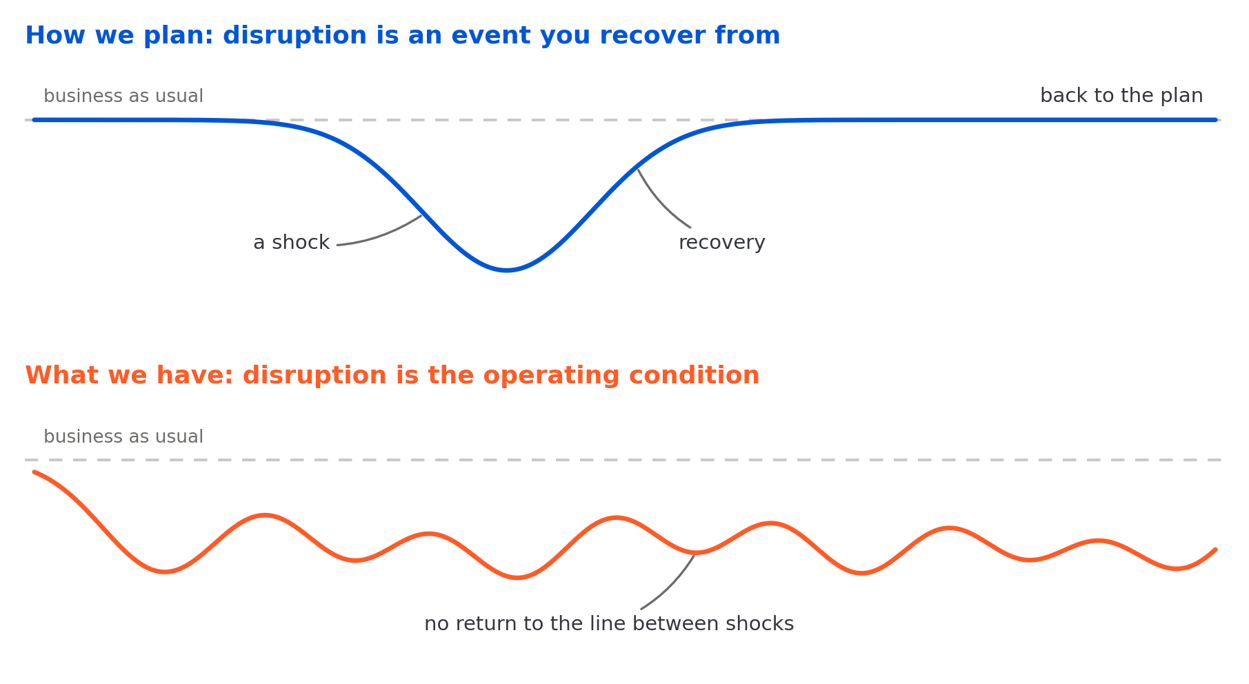
Turn on the news most mornings and something has happened, somewhere, that will reach your business within a quarter or two. Covid, Brexit, wars, energy shocks, tariffs, raw material costs reaching the shelf edge. I’ve been in retail for over twenty years and there have always been challenges to adapt to. What feels different is the spacing, with shocks now arriving so close together that the industry never gets back to a steady state between them. There is no “after”.
Collins Dictionary made permacrisis its word of the year in 2022, defining it as an extended period of instability where one crisis runs into the next without a return to normal in between.
The problem isn’t the crises. It’s how we plan around them
Almost everything about how a retail business plans assumes an “after”. The annual budget sets a course, the quarterly review corrects against it, the monthly reforecast tidies the variance. All of it rests on treating disruption as an event you absorb before returning to the plan.
The industry seems to know that’s no longer true. Gartner’s 2026 CIO Agenda found 94% of technology leaders expect major strategic pivots ahead, while only 18% reprioritise off-cycle. We are near unanimous the plan will break and still plan as though it won’t.
What it looks like in retail
The wider picture is not subtle. In the World Economic Forum’s Global Risks Report 2026, just 1% of experts expect a calm outlook over the next two years. AlixPartners gives the retail-specific version, finding that only 8% of retailers expect minimal change to their business model over the next twelve months.
More interesting is how the industry has absorbed it. Deloitte’s 2026 retail outlook found 95% of retail executives anticipating cost increases from global trade policy, while 96% still expect revenue growth. Read those together and you get something other than pessimism: retailers have stopped treating cost shocks as exceptional and now plan around them as permanent. The disruption has been priced in. The planning cycle it gets priced into has not.
For retailers it often lands on the digital roadmap first. Research by PMC and Retail Economics across more than 100 senior UK retail leaders found ROI and economic uncertainty are the biggest barrier to digital transformation, cited by 35%, ahead of legacy systems. Retail Economics’ Richard Lim frames it as “a trade-off between the need to invest in innovation versus other, often competing, business needs around cost saving and margin protection.”
Closer to home, UK retail employment costs rose by more than £5 billion in a single year, and high street jobs fell by nearly a fifth between 2015 and 2024. The BRC’s Helen Dickinson calls it a growing “cost-of-doing-business crisis”. Not one bad year. A decade of compression.
Sceptics have a fair point about the word itself. Every generation thinks its own turbulence is unprecedented. Fair enough, though it doesn’t change the planning problem.
Crisis response isn’t an operating model
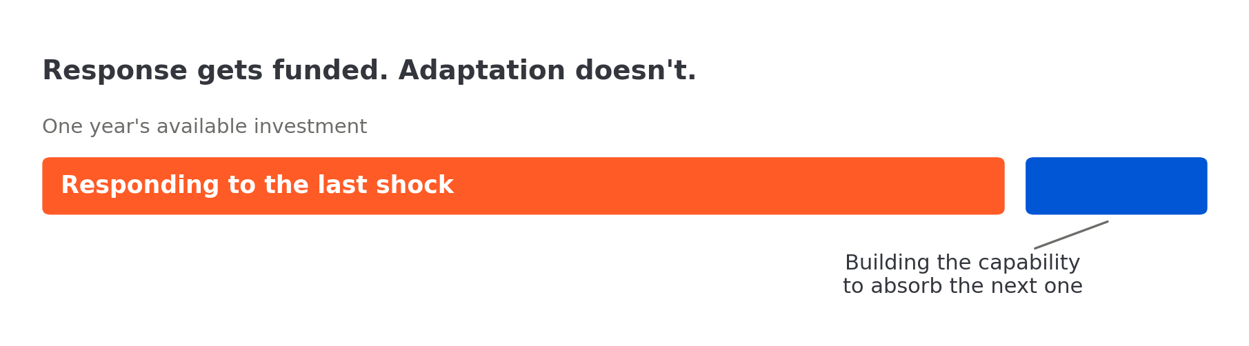
You can convene a crisis meeting for a crisis. What you cannot do is convene one every few weeks for five years and call it a strategy. That, near enough, is where many organisations have ended up, permanently braced and running the business on escalation.
The cost is a funding one. Every shock demands a response, paid for from the same pot that would have funded the next initiative. Tariffs land, so margin gets re-engineered. Costs jump, so the replatforming case goes back in the drawer. Nobody signs off extra budget for the future, so capex is consumed absorbing the last crisis and the capability to absorb the next one never gets built.
Settling into it
If instability is the baseline, the honest move is to stop treating each shock as an exception and start designing for the condition. Three things follow.
Replan on events, not the calendar. Keep the annual budget for governance, but let a change in conditions trigger reprioritisation rather than the arrival of Q3.
Break big programmes into increments that pay for themselves. A three-year transformation is a bet on three years of stability. Quarterly increments help you survive the next shock, and they can be reprioritised or paused without writing off the investment.
Optimise what you already own first. Overlapping systems, underused licences, inflexible contracts. There’s usually real capacity, and real cost, inside the existing estate, and releasing it doesn’t need a capex approval cycle.
Where we can help
There’s a reason we built our Proactive Managed Service around continual improvement rather than periodic projects. It changes the funding shape of adaptation, turning what would be a capex case competing with the last crisis into an ongoing capability. Learn more on our dedicated service page, www.ayatacommerce.com/managedservices
If continual disruption really is the baseline, the advantage goes to those who adapt fastest with what they already have. If that’s a conversation worth having, get in touch (ayatacommerce.com/contact-us). I’d welcome it.
And if you’d simply like to compare notes, email me directly. I’m always interested in how others are approaching this, and glad to put time aside for a proper conversation.
nigel.hunter@ayatacommerce.com


