



Benjamin Franklin’s words still ring true, “A small leak will sink a great ship.” In the complex world of multi-marketplace e-commerce, small, overlooked costs and hidden fees gather like drops forming a tide, applying pressure on profit margins and threatening even the strongest businesses. Identifying and sealing these margin leaks is critical to sustaining financial strength and achieving sustainable growth.
Retailers managing sales across their own sites and global marketplaces face a significant profitability challenge driven by the intricate and varied cost structures of each marketplace. Although customers see identical prices across channels, the costs to sell on marketplaces can vary dramatically. Each marketplace imposes a unique mix of referral commissions, fulfilment charges, storage fees and seasonal surcharges, all impacting profitability. These differences intensify with international expansion. For instance, a US retailer selling in the UK or Europe should account for foreign marketplace fees, tax regimes and cross-border logistics, stretching cost disparities and complicating margin management. Understanding and mastering these nuanced cost differences is essential to protecting healthy margins in a multi-channel world.
Understanding Margin Leakage for Marketplace Retailers
Margin leakage presents a substantial threat, even to market-leading sellers and its impact intensifies in complex marketplace environments due to several key factors:
- Retailers face layered costs such as referral commissions, fulfillment surcharges (including FBA fees), cross-border taxes and penalties for missed service level agreements (SLAs). These fees create a cost structure significantly different from selling via proprietary websites or physical stores.
- Maintaining consistent prices across channels means marketplace-specific costs cannot simply be recouped by raising prices. Profits earned on a retailer’s own platform may be lost when selling on marketplaces if these costs are not properly accounted for.
- When expanding globally, additional local expenses, such as currency conversion fees, VAT and import duties further erode what were previously healthy margins.
- Returns impose a heavy burden, with rates often exceeding 15-50%, particularly in categories like apparel and electronics. Unlike direct-to-consumer sales, retailers lack ownership of customer relationships on marketplaces, complicating returns management. The cumulative costs, including reverse logistics, restocking, shipping, disposal of unsellable stock and return fraud not only drain margins but also inflate operational complexity.
- Obligatory advertising spends to secure the Buy Box or mandated promotional activities can rapidly alter margin equations, especially impacting slow-moving or frequently returned products.
Without integrated, real-time modeling and comprehensive tracking of these factors, retailers risk allowing margin leakages to accumulate unnoticed, potentially resulting in significant profit losses. Only by integrating all variable costs, including fee structures, inventory turnover rates and channel-specific requirements, can marketplace sellers safeguard their margins and make truly informed decisions.
From Margin Insights to Actions
Moving beyond gap identification, retailers must deploy precise tactics to plug margin leaks. Marketplace environments demand vigilant automation, continuous financial visibility, and dynamic responsiveness to defend every profit percentage point. The following strategies guide marketplace sellers balancing competitiveness with profitability when pricing flexibility is limited but cost control is paramount.
Strategy 1: Save Margins with Real-Time Inventory Visibility
Real-time inventory visibility forms the backbone of margin protection. A unified, up-to-the-minute picture across marketplaces, websites, and stores empowers anticipatory, strategic decisions rather than reactive fixes.
For example, a retailer expanding from the UK to the US may face local stockouts. Smart backorder management, enabled by real-time inventory insights, allows continued sales with transparent fulfillment lead times (e.g., 2 days), preventing lost sales, emergency costs and preserving customer trust.
Strategy 2: Fully Integrated Smart OMS Powers Efficient Multi-Channel Coordination
A smart Order Management System (OMS) integrates all selling channels and fulfilment touchpoints, delivering:
- Real-time synchronization of inventory and orders across marketplaces, websites, and physical stores to prevent costly overselling, vital during flash sales or product launches.
- Automated prioritization of backorders, oversize shipments and expedited deliveries balancing cost and speed.
- Seamless multi-region routing optimizing logistics, currency conversion, and tax compliance.
- Coordination of complex returns workflows, improving refund accuracy and reducing cost.
- Detailed SKU- and channel-level margin analytics enabling targeted pricing, promotions, and inventory management.
- Proactive order volume tracking across channels aids optimal product placement and stock allocation based on what’s selling, where and when. This means sellers can easily decide which products to promote and distribute in each channel, maximizing sales and inventory health.
For instance, a major Amazon and Walmart seller uses smart OMS to update stock instantly across platforms, avoid overselling, reroute backorders automatically and optimize fulfillment paths, saving thousands monthly in error and expedited shipment costs.
Strategy 3: Implement Remorse Hold to Minimize Costly Returns
High return rates disproportionately threaten marketplace seller margins. A remorse hold policy introduces a brief reservation window prior to order processing, reducing impulse or hesitation-driven returns.
Integrated with inventory and order management, remorse hold locks reserved stock, returning it to sale if the order is not finalized within the set period, preserving inventory accuracy across channels. Effective implementation requires tight coordination between sales and inventory teams, supported by OMS integration to prevent overselling or stockouts.
Strategy 4: Utilize AI-Powered Price Crawlers and Dynamic Pricing Automation to Maximize Competitive Pricing and Margin
In competitive marketplaces, quick intelligent pricing decisions are critical. AI-powered price crawlers continuously monitor competitor prices, stock levels and promotions across multiple channels, instantly flagging misalignments.
Dynamic pricing automation leverages these insights combined with inventory levels, historical sales data, marketplace fees, and margin targets to adjust prices automatically within channel rules, avoiding price wars while maximizing profitability and Buy Box placement.
Retailers managing thousands of SKUs experience efficiency gains by automating widespread price updates. For sellers with long-tail inventory (large volumes of slow-moving products), AI analyzes sales data and current pricing to recommend optimal discounting timing, accelerating stock clearance without compromising margins. Centralized pricing ensures simultaneous, consistent price and bundle updates across all channels, reinforcing brand trust and marketplace compliance.
Bundling tactics enhance average order value and offset rising transaction fees, strengthening margins further. Together, these technologies form a scalable pricing ecosystem boosting profitability and agility.
Strategy 5: Real-Time Reconciliation to Track and Act on Margin Leakages
Real-time reconciliation serves as the financial nerve centre for marketplace sellers, providing continuous detailed visibility across every transaction, from orders and returns to fees and payments. This empowers immediate identification and resolution of margin leaks before losses escalate. Retailers can dynamically reroute orders for cost-effective fulfillment, pause unprofitable advertising or proactively manage listings to avoid marketplace penalties.
For example, discovery of excess storage fees due to aged inventory through automated reconciliation enabled a retailer to optimize stock levels, recapturing an estimated 5% of lost profits within months. Such relentless financial intelligence is vital for profitable multi-marketplace growth.
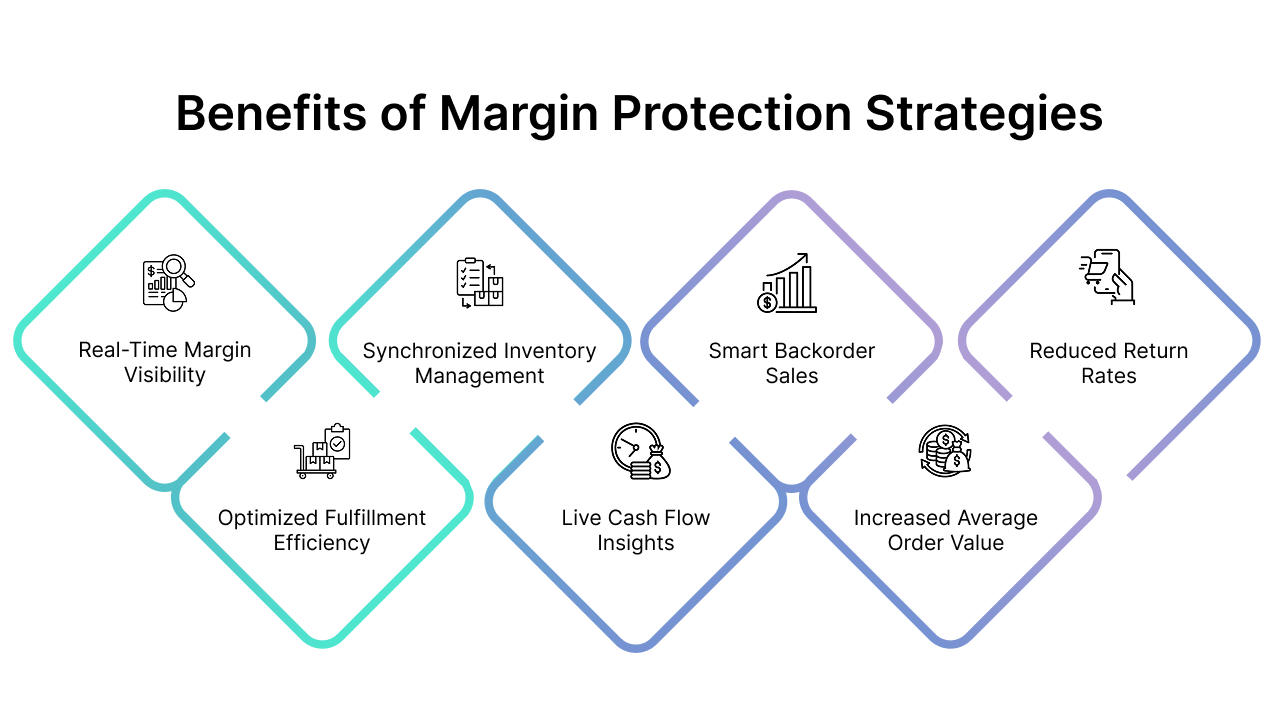
- Real-Time Margin Visibility
Instant, accurate insights into product margins across all channels, eliminating surprises. - Synchronized Inventory Management
Seamless inventory and order syncing prevents costly overselling. - Smart Backorder Sales
Strategic sales of out-of-stock items protects brand reputation and revenue. - Reduced Return Rates
Remorse hold and smarter engagement cut time and cost of returns. - Optimized Fulfilment Efficiency
Automation prioritizes shipments for regional cost and speed benefits. - Live Cash Flow Insights
Continuous profit trend monitoring guides financial decisions. - Increased Average Order Value
Reduced margin leakage and smarter purchase behaviour boost order sizes.
Why Margin Optimization Is Critical Today
Marketplaces have become the core drivers of e-commerce growth. Effective margin management is imperative for leadership seeking sustainable expansion and profitability. Marketplace costs, such as commissions, fulfillment, advertising, regional taxes, while complex, can be strategically managed to unlock competitive advantage. The evolving retail landscape demands balancing customer expectations i.e. speed, returns and service with prudent cost control. Seasonal peaks, promotions, and market fluctuations introduce volatility requiring real-time visibility into costs, sales and policies.
Increasingly, sellers are investing in direct-to-consumer channels to gain greater control over pricing, branding and customer data. For those concurrently selling on marketplaces, integrated margin management that bridges channels is essential for operational efficiency and margin preservation.
Automation, recognized by 91% of marketplace sellers as business-critical, paired with real-time insights and smart margin tactics, comprises the foundation for success in 2025 and beyond.