


De-risking ERP and boosting omnichannel margins.
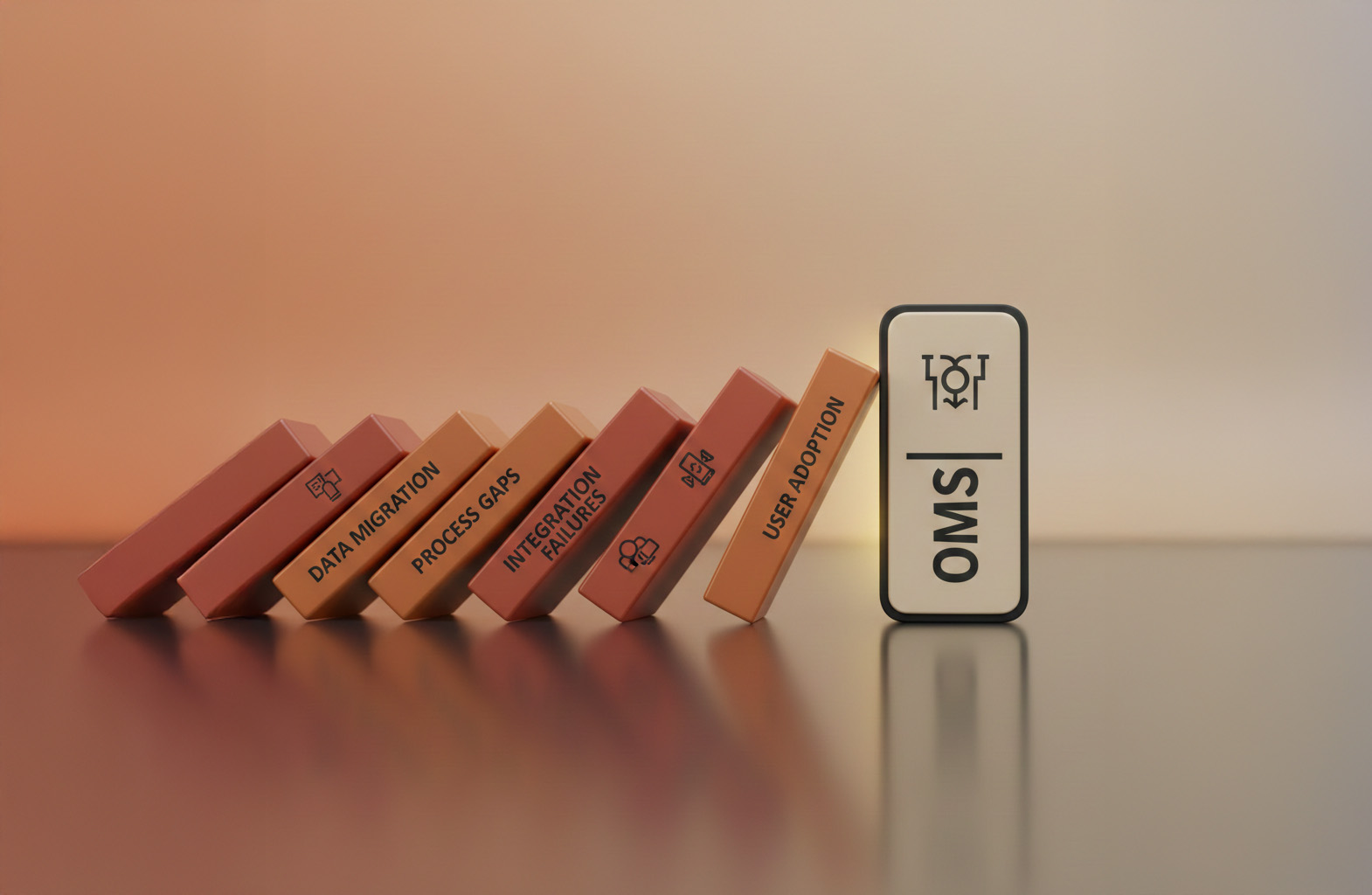
Every organization believes their next ERP program will be cleaner, faster, more controlled. Most follow the same arc, where the first phase delivers hope, the second brings fatigue and by phase three, “stability” becomes the new definition of success. Somewhere along the way, the goal shifts from transformation to survival. That’s where the real conversation about ERP vs. OMS should begin.
Many ERP programs stumble because businesses try to make one platform serve too many masters, including financial control, inventory tracking, omnichannel orchestration, real-time customer experience and every operational nuance in between. The more the ERP stretches, the more fragile it becomes.
Why ERP Struggles in an Omnichannel World
ERP systems were built for control and governance. They excel at closing the books, managing procurement and handling compliance, however, the rapid pace of digital commerce, distributed fulfillment and multi-marketplace expansion pushes ERP beyond its intended role.
Here’s where it gets tricky. An ERP can tell you what’s in stock and where it sits. Modern commerce, however, demands more dynamic answers, like, “Can I promise this product to that customer, from the best location, with full margin visibility and hit the delivery promise?” It’s a question of orchestration and that’s where the limits appear.
When businesses stretch ERP to answer these questions, they often expose it to high-volume web-facing API calls. This is risky. ERP is designed for internal, controlled access, not for being hit directly by every customer order on the web. Exposing ERP to web channels creates two major problems:
- System overload during high-volume events like flash sales, where thousands of API calls can slow or destabilize ERP.
- Security exposure, expanding the attack surface for your core system.
The result is slower release cycles, fragile integrations and increasing operational risk every time a new change request appears. Finance, planning and supply chain teams see performance degrade as ERP struggles to keep up.
At that point, leaders start to sense the imbalance. Finance wonders why so much budget sits locked inside ERP customizations. Operations teams worry about update freezes and downtime. Technology teams see technical debt growing with every release note. The executive question shifts from “When will the new ERP go-live?” to “How much more can we safely add to it?” This is where the conversation about ERP and OMS changes.
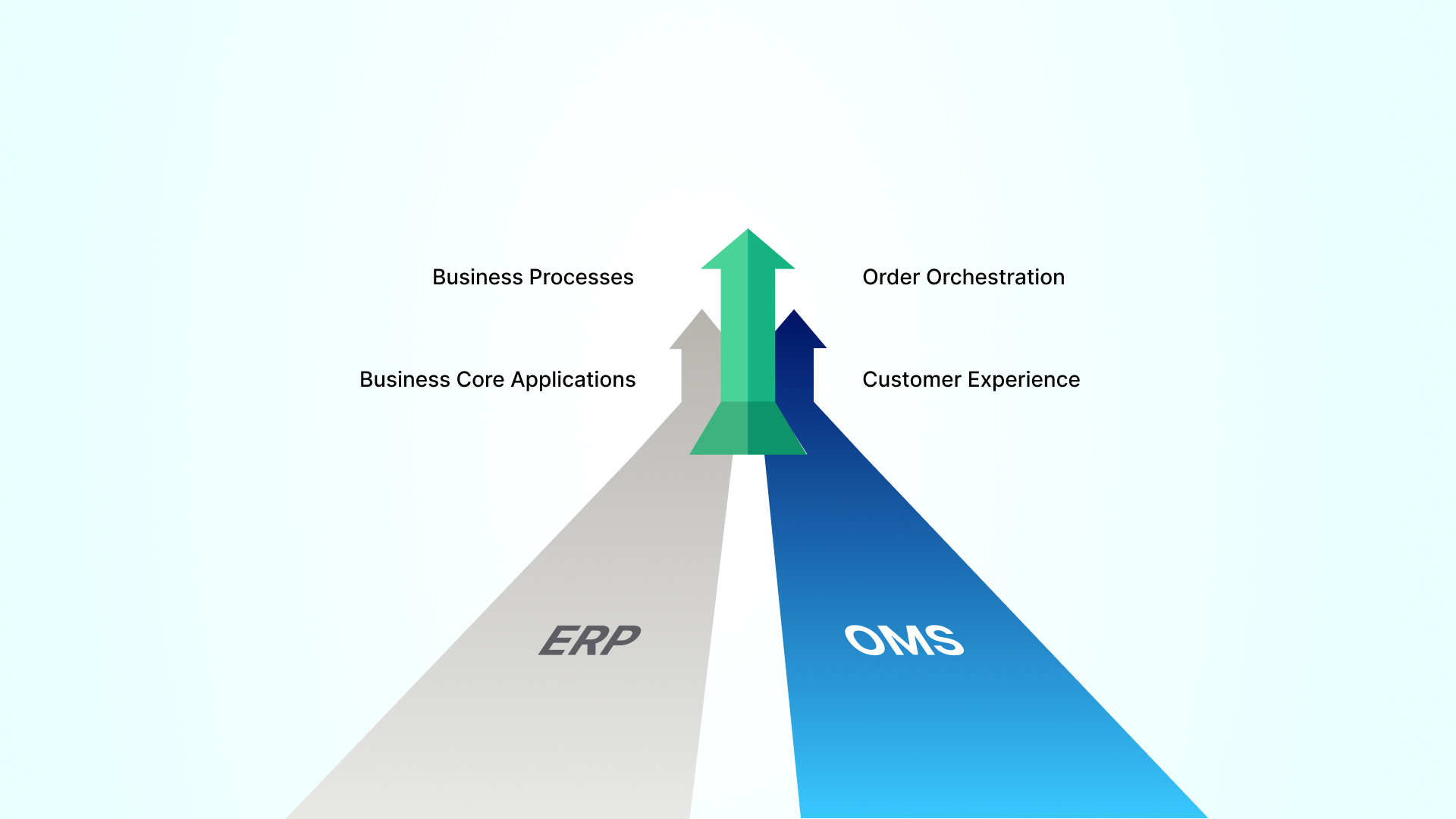
Not “ERP or OMS”, but “ERP and OMS”
Do we replace the ERP?
Do we bring in an OMS?
ERP vs OMS – which is right?
When organizations look for improvement, the conversation is often framed as an either or dilemma. In practice, these two systems were built for different roles and their true value emerges when they operate together. ERP remains the operational backbone, managing core processes end-to-end, recording product movements and financial transactions, supporting planning and compliance and keeping auditors satisfied. It’s designed for accuracy, traceability and governance, the qualities every enterprise depends on.
An Order Management System plays a distinct role in the operational landscape. It serves as the orchestration layer and “brain” for orders, making fulfillment decisions based on a continuously updated, network-wide view of inventory from warehouses, stores, vendors and 3PLs. This unified, real-time view enables the OMS to answer complex questions like “What’s available, where and how do I fulfill this order most efficiently?” Rather than acting as the system of record for inventory, the OMS uses data to orchestrate fulfillment, functioning like a traffic controller.
Because the OMS handles these fulfillment decisions, each sales channel connects to it first, not directly to the ERP. The OMS then communicates with ERP, WMS, 3PLs and store systems via standardized APIs. This keeps ERP close to its core functions, while allowing the OMS to manage high volume, real-time decisions, such as, intelligent available-to-promise (ATP), reliable delivery dates and complex scenarios like ship-from-store, click-and-collect, returns routing, split shipments and preorders.
The separation of roles transforms the architecture from rigid to adaptable, where ERP retains its integrity and remains easier to upgrade and less exposed to operational overload and OMS absorbs the pace and complexity of digital commerce. Together, they deliver the control and responsiveness that modern enterprises need. So, instead of asking which platform should bear the weight of modern commerce, the smarter question would be, how to let each system do what it does best.
How an OMS First Strategy De-Risks ERP Programs
There’s a misconception that introducing an OMS is an extra layer. An OMS-first approach simplifies the landscape. It externalizes orchestration and integrations that would otherwise sprawl inside ERP maintenance cycles which makes transformation safer, faster and easier to measure.
1. Cost Efficiency Without Shortcuts
Every customization inside ERP is a future liability. By relocating order logic to the OMS, you keep ERP lean and reduce customization debt. Future ERP upgrades then focus on financial accuracy and process compliance rather than rebuilding fulfillment logic from scratch. Integration cost also drops because the OMS becomes a single, consistent hub. Channels connect once to the OMS instead of creating multiple point-to-point bridges into ERP and legacy systems. Over time, this flattening of the integration map lowers both CapEx and ongoing support spend.
2. Risk Mitigation That Protects Operations
ERP go-lives often feel like “all or nothing” events. However, OMS-first architectures remove that tension. Orders can continue flowing while ERP changes happen behind-the-scenes. Dual run modes become predictable. Even during upgrades or Mergers and Acquisitions (M&A) consolidation, daily operations remain stable. In short, business continuity stops depending on ERP uptime alone, enabling transformation without disruption.
3. Revenue Acceleration Through Better Promise Accuracy
Commerce teams thrive when systems tell the truth in real time. Accurate ATP, intelligent sourcing and unified inventory visibility directly lift conversion and customer satisfaction.
When the OMS exposes hidden stock across Distribution Centers (DCs), stores and suppliers, lost sales decrease. When delivery promises are met consistently, brand trust deepens. These revenue gains compound steadily without extra marketing spend or operational burden.
4. Agility at Scale
Every growing brand faces pressure to add new marketplaces, channels and fulfillment nodes. In traditional ERP-centric landscapes, each addition triggers a long integration project. In an OMS-led design, it’s configuration rather than reconstruction.
New channels, 3PLs or acquired entities can plug into standardized APIs and orchestration rules. The OMS handles variations, freeing up ERP to focus on its core functions. This flexibility pays off especially in post-merger scenarios or regional expansions where speed to integration defines success.
Modernization With Control
Here the key takeaway is, ERP modernization doesn’t have to paralyze your business growth. With an OMS-first strategy organizations modernize around the core while protecting it, gaining speed and resilience before touching the backbone. This approach enhances ERP investments by leveraging the strengths of both systems. It creates a modernization path where OMS delivers immediate value, while ERP evolves methodically and safely. Immediate gains show up in fulfillment accuracy and conversion, while long-term benefits appear in lower technical debt and reduced total cost of ownership.
To implement this approach, start with a single journey, perhaps online orders from a single region or marketplace. Route them through the OMS first. You can measure the impact, such as reduced manual effort, smoother ERP performance and fewer errors, before expanding to new flows and channels. Step by step, your business becomes both more responsive and scalable.
A Better Question to Ask
Seen through this lens, ERP vs. OMS is the wrong debate. ERP remains the backbone that keeps the enterprise disciplined and reliable. OMS is the orchestration layer that lets the business breathe, respond and grow.
So, the question isn’t which one wins. It’s how much risk are you willing to keep inside your ERP when a smarter, safer layer can carry the weight for you. Modernization done right means protecting what matters while freeing the rest to move faster. That is where the OMS-first roadmap begins.